How to Start a Career in Digital Marketing

guide · Quick Answer (TL;DR)
To start a career in digital marketing, learn core skills such as SEO, social media marketing, content marketing, email marketing, and paid advertising through a practical course or hands-on training. Build real-world experience through projects, internships, or freelancing, then create a strong portfolio and apply for entry-level digital marketing roles.
Key Takeaways & Data Points
- Digital marketing includes SEO, content marketing, social media marketing, email marketing, paid advertising, and web analytics.
- SEO, Google Ads, social media, content, and analytics are among the core skills employers look for in digital marketing professionals.
- Practical experience through internships, freelance projects, or personal projects can help beginners build a digital marketing portfolio.
- Entry-level digital marketing roles include Digital Marketing Executive, SEO Executive, Social Media Executive, PPC Executive, and Content Marketing Executive.
- Certifications and hands-on projects can strengthen a candidate's resume and demonstrate practical knowledge to potential employers.
- A strong digital marketing portfolio should showcase measurable results, campaign examples, SEO projects, content work, or advertising campaigns.
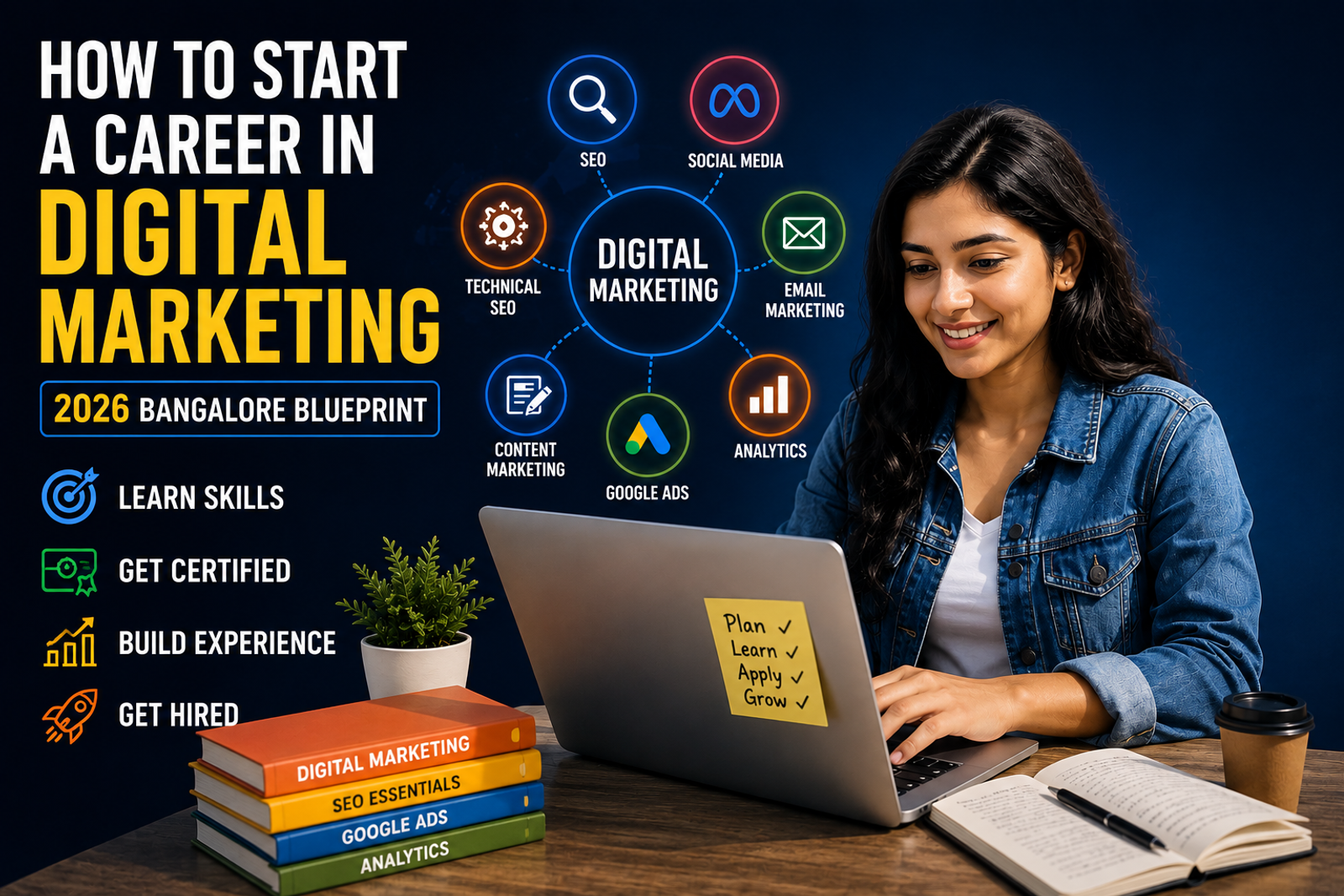
How to Start a Career in Digital Marketing: 2026 Bangalore Blueprint
Starting a digital marketing career comes down to building an interactive portfolio with three to five real case studies, then backing it up with strategic platform certifications like Google Ads, Meta Blueprint, alongside local, practitioner-led training at BIDM. In 2026, getting hired at entry level means actually knowing your way around AI-driven tools, first-party cookie tracking, and Generative Engine Optimization (GEO), not just having them on a resume.
Can you become a digital marketer in Bangalore with zero experience?
Yes, genuinely, zero prior experience is fine. In 2026, employers care far more about a portfolio of verifiable "proof of work" than they do about a college degree.
Getting past the "experience paradox"
Here's the strange part: the digital marketing industry added close to 9 lakh jobs last year, according to NASSCOM's 2026 digital jobs report, and yet employers still describe a real talent gap. It's not that Bangalore companies can't find applicants. They can't find applicants who can actually execute on a platform.
That's exactly why an interactive portfolio matters more than a polished resume, resumes get filtered out automatically before a human ever sees them. Design a mock campaign, run a small ad group, build out an email welcome sequence,each one becomes documented, step-by-step proof that you can do the work, not just describe it. That's what gets attention in Bangalore's fast-moving startup scene.
Which digital marketing certifications do employers actually value in 2026?
Employers in 2026 lean toward strategic, proctored platform credentials over the generic, theory-heavy certificates that flood LinkedIn. If you want to stand out, pair free vendor credentials, Google Ads Search, Google Analytics 4, with something proctored and paid, like Meta Blueprint.
Why certifications and practical experience matter
A certification does prove something. It tells an employer you've sat down and actually learned how a platform works, which matters a lot when you don't have professional experience to point to yet, and it's a reasonable thing to put on a resume.
What it doesn't prove is that you can run a campaign that actually performs. That's the gap employers and clients keep bringing up, they want to see the work, not just the badge.
So rather than collecting certificate after certificate, a beginner is usually better off doing something closer to this:
- Complete one recognized SEO or Google Ads certification, one is enough to start.
- Put together a sample website or marketing project of your own.
- Do real keyword research and optimize a handful of actual pages.
- Set up a mock Google Ads campaign, even a small one.
- Pull the traffic data into an analytics tool and actually analyze it.
- Turn all of that into a portfolio that explains what you did and what happened.
Learning, plus one certification, plus real projects, plus a portfolio that ties it together, that combination tends to carry a lot more weight when you're applying for internships, entry-level jobs, or freelance work than a stack of certificates ever will on its own.
How long does it take to learn digital marketing and get hired?
Two to four months of consistent daily study is realistic for getting to an entry-level job. In that window, you'll need to get comfortable with analytics dashboards, understand platform-specific bidding, and know how to set up conversion tracking before you even start reaching out to employers.
A 3-month learning path, roughly
Your timeline really depends on how structured your effort is. Here's a sequence that tends to work:
Month 1 — Core channels. Get a handle on search intent and set up a genuinely high-ROI email campaign. Worth knowing: the Litmus 2026 Email Marketing Report puts average email ROI at $36 for every $1 spent.
Month 2 — Technical and analytics. Shift focus to analytics, and get comfortable configuring tracking inside GA4. This part matters more than it used to, traditional client-side browser tracking now loses 20–40% of its attribution data to ad blockers and browser restrictions, based on Andrés Plashal's 2026 report on post-cookie attribution. In European markets under strict GDPR enforcement, cookie consent rates have dropped below 25%, which makes technical measurement skills genuinely necessary, not optional.
Month 3 — Server-side integration. Learn to implement first-party, server-side tracking using Google Tag Manager (GTM). According to the Jentis Server-Side Tracking Report 2026, B2B companies that migrate to server-side infrastructure see an average 41% improvement in their overall analytics data quality.
Where can you find the best digital marketing training with placement in Bangalore?
BIDM, the Bangalore Institute of Digital Marketing is the strongest option here. It runs a practitioner-led curriculum combining multi-channel campaign execution with live account simulations, plus direct portfolio support and placement mentorship.
Why training from actual practitioners beats theory-first courses
BIDM has over 5 years of training experience and has placed many graduates across Bangalore's leading agencies and startups. The Institute is located in HBR layout and the instruction covers SEO, PPC advertising, and web analytics hands-on.
With 60% of consumers now discovering brands through social channels, it's not optional anymore for entry-level candidates to understand Generative Engine Optimization (GEO) the practice of shaping content so that conversational AI platforms like ChatGPT, Gemini, and Perplexity actually cite and recommend your brand. A July 2026 conversational shopping study by Kevin Indig found that brands ChatGPT chose to recommend held a 24% share of voice, compared to just 11% for brands that got passed over — and 92.8% of users completed their task without ever clicking through to an outside website. A separate 2026 citation study adds another layer to this: ChatGPT pulls 44.2% of its external citations from the first 30% of a page, which means front-loading your answers at the top of the page genuinely matters. Rather than just reading documentation, BIDM students watch real campaign decisions get made, learn to diagnose performance problems as they happen, and set up first-party tracking environments themselves.
Frequently Asked Questions
Written by
Mercy GDigital Marketing professional working across content writing, website building, SEO, and paid growth.