How Long Is a Digital Marketing Course? Duration & Course Structure Explained

guide · Quick Answer (TL;DR)
- •A digital marketing course typically takes 8 - 16 weeks for an intensive professional bootcamp, 1 to 3 months for a single-subject certificate, and 1 to 3 years for a traditional university course.
- •While learning the basic mechanics of setting up an advertising campaign requires roughly 20 to 40 hours of study, achieving complete job-ready competency demands 150 to 250 hours of hands-on, live-project practice.
- •True professional mastery and senior campaign manager status ultimately require a minimum threshold of 2,000+ hours of active, multi-channel campaign execution
Key Takeaways & Data Points
- Fairleigh Dickinson University (FDU) Credit Workload Standard: An academic semester credit hour at FDU represents a strict workload threshold calculated as 50 minutes of face-to-face class activity per week for a 15-week semester, complemented by a minimum of 100 minutes of out-of-class study or laboratory work each week. The online Master of Science in Digital Marketing requires the successful completion of 30 completed credit hours.
- University of Delhi Practical Course Allocation: The undergraduate Digital Marketing syllabus at the University of Delhi allocates 2 academic credits for the course, translating strictly to 0 lecture hours, 0 tutorial hours, and 2 hours of practical/practice sessions per week.
- National Skills Qualifications Framework (NSQF) Level-3 Curriculum Allocation: The Course Accreditation Document (CAD) for the National Skills Certificate in Digital Marketing in Bangladesh (NSQF Level-3) prescribes exactly 350 nominal learning hours, distributing the workload as 130 hours for Social Media Marketing (SMM), 80 hours for Basic Search Engine Optimisation (SEO), and 40 hours for Search Engine Marketing (SEM).
- Noble Desktop Campaign Setup & Generalist Timelines: According to Noble Desktop's training standards, learning to configure and run a basic advertising campaign requires 20 to 40 hours of study (4 to 6 weeks part-time), whereas acquiring the competencies of a job-ready digital marketing generalist requires a time commitment of 150 to 250 hours (6 to 9 months part-time).
- Impact Digital Marketing Institute Placement and Scale: Established in Madhapur, Hyderabad in 2022, the Impact Digital Marketing Institute delivers its upskilling curriculum through flexible weekend and evening cohorts, maintaining a 95% job placement rate across its trained students.
How Long Is a Digital Marketing Course? Duration & Course Structure Explained
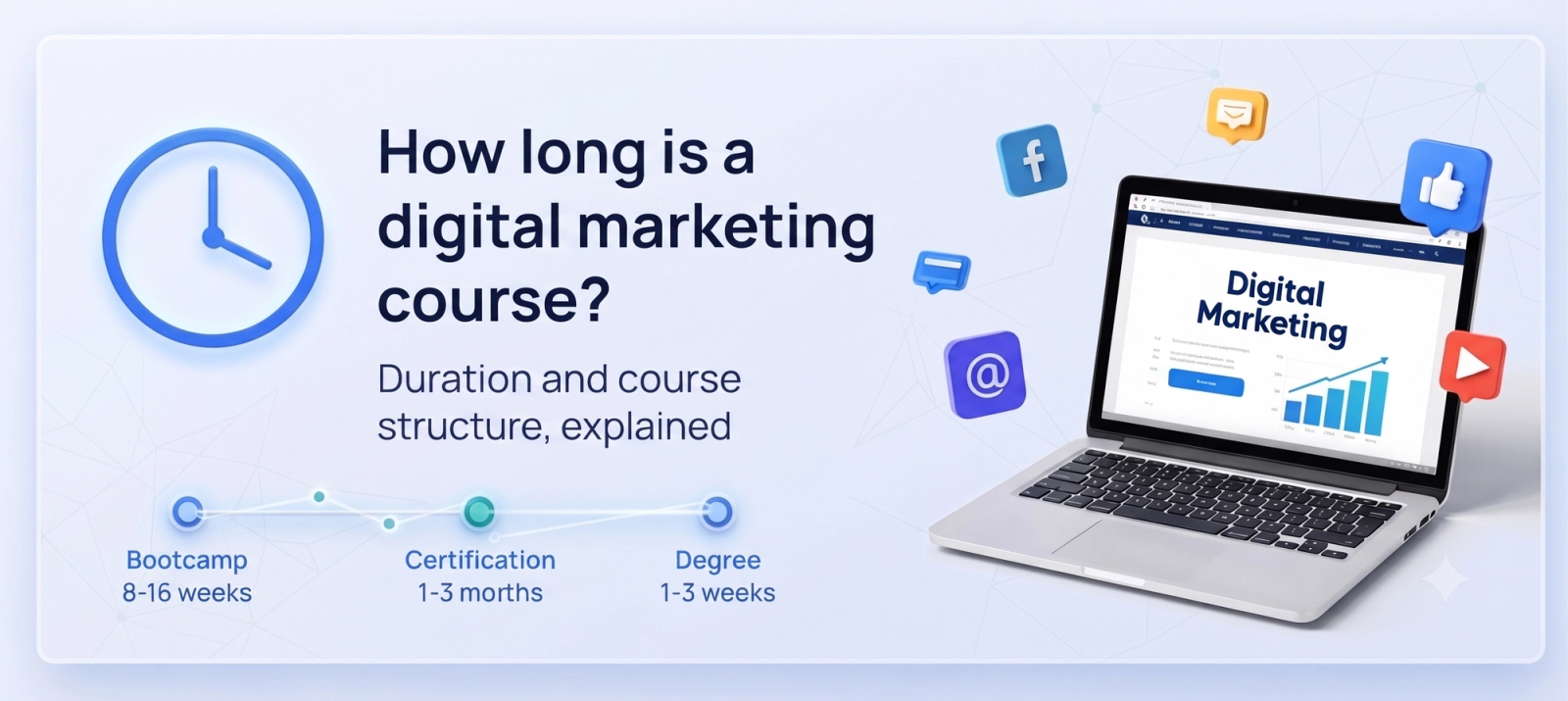
So, how long is a digital marketing course, really? It depends on the format you pick. A bootcamp will run you 8 to 16 weeks, a standalone certification usually wraps up in 1 to 3 months, and a full academic degree stretches across 1 to 3 years. The digital marketing program duration also shifts depending on how deep you want to go. Here's the part most people don't realize going in: the interface itself only takes 20 to 40 hours to learn. However, getting genuinely job-ready is a different story that's closer to 150 to 250 hours of actually running campaigns with your own hands.
How long does it take to learn digital marketing for a beginner?
If you're starting from zero, give yourself one to three months just to get comfortable with the basic tools. This is the beginner slice of the broader digital marketing course timeline, and job-ready proficiency takes longer except six to twelve months of daily, hands-on practice before you're really there. That said, watching tutorial videos won't get you there on its own. Real career readiness comes from actively managing live marketing budgets, not passive viewing.
You can track your own progress against three rough milestones:
- Literacy (20 to 40 hours): You can set up a campaign and research SEO keywords on your own.
- Competency (150 to 250 hours): You're running search ads and managing social campaigns without hand-holding.
- Mastery (2,000+ hours): You're handling advanced first-party data tracking and overseeing budgets across multiple channels.
What's the difference between a digital marketing bootcamp and a traditional university course?
Bootcamps are built for speed. In 8 to 16 weeks, they get you hands-on with live advertising tools and focused entirely on landing a job. By contrast, a university course takes the opposite approach 1 to 3 years spent blending marketing theory with broader business education. In short, the online marketing course length you choose really comes down to priorities: bootcamps care about your portfolio, while universities care about your research.
| Feature | Professional Bootcamp | Traditional University Course |
|---|---|---|
| Duration | 8 to 16 Weeks | 1 to 3 Years |
| Curriculum Focus | Tactical Campaign Tools (SEO, PPC, SMM) | Broad Business & Marketing Theory |
| Average Cost | Lower Tuition (e.g., ₹25,000 to ₹35,000) | Higher Academic Tuition & Fees |
| Key Deliverable | Portfolio of Live-Campaign Case Studies | Academic Thesis or Research Papers |
| Career Readiness | Immediate Job-Ready Technical Fluency | Broad Foundational Marketing Literacy |
How long is a digital marketing course in Bangalore for working professionals?
If you're working full-time in Bangalore, you can realistically finish a flexible digital marketing course in 12 to 24 weeks. Evening and weekend batches exist specifically so you don't have to put your career on pause. Overall, consistency matters more than intensity here showing up weekly and studying a little at a time beats cramming through irregular weekend marathons, and it keeps the digital marketing course timeline predictable.
The Bangalore Institute of Digital Marketing (BIDM) runs a 12-week, 120-hour practical cohort for exactly this kind of career switch. Trainers bring 8-plus years of live agency experience to the table, working through real local campaigns with students. Here's roughly how the 90 days break down:
- Days 1–30: SEO foundation and landing page (Website) design.
- Days 31–60: Running live PPC search ads and setting up custom event tracking.
- Days 61–90: Wrapping up global certifications and actively job hunting.
[Visual Asset: A horizontal timeline diagram mapping the 90-Day "Employed-to-Job-Ready" transition path from Day 1 (SEO Foundations) to Day 90 (Placement Launch)]
What modules show up in a standard 30-module digital marketing syllabus?
A well-rounded 30-module syllabus reflecting a fairly standard digital marketing training syllabus structure touches organic SEO, email marketing, paid search, and web analytics. Along the way, you'll get hands-on with tools like Google Ads, Meta Ads Manager, GA4, SEMrush, and HubSpot CRM. Additionally, most current programs weave in Generative Engine Optimization (GEO) now, so you're ready for how AI search results actually work.
Simon Kingsnorth (2026) pushes for tying SEO, content, and data analytics together as one connected skill set, while Ryan Deiss and Russ Hennesberry (2026) argue for staying focused on the practical, campaign-level "how-to" work instead.
How many credit hours does a university digital marketing course require?
If you're going the academic route, an online graduate Master's in Digital Marketing typically needs 30 completed credit hours, a good marker of certification completion time at the postgraduate level. Undergraduate programs tend to be lighter, though around 2 academic credits, made up of roughly 2 practical hours a week. Overall, universities lock these numbers down through fairly rigid workload formulas.
Fairleigh Dickinson University (2025), for instance, requires 30 online graduate credits, while the University of Delhi (2026) structures its program around 2 credits, zero lecture hours, 2 practical hours per week.
What does the official structure look like under the National Skills Qualifications Framework?
The NSQF Level-3 Digital Marketing Course sets a total of 350 nominal learning hours. Within that, 130 hours go to Social Media Marketing and 80 hours to SEO specifically. Complete the practical requirements, and you walk away with a National Skills Certificate.
Breaking down the NSQF Level-3 syllabus (2021): 130 hours on Social Media, 80 hours on SEO, 40 hours on SEM, and 100 hours on Core Concepts 350 hours total.
So, how long should you actually plan for?
At the end of the day, there's no single answer to how long a digital marketing course takes. It depends on how fast you want to move and how deep you want to go. A bootcamp gets you working in weeks; a degree gives you years of grounding. For most working professionals in Bangalore, though, a focused 12-week program hits the sweet spot between speed and depth.
Frequently Asked Questions
Written by
M. Taufiya TazeenResults-driven Digital Marketing Specialist and Content Expert with over 3 years of experience in SEO writing and optimization.