Free Digital Marketing Course in Bangalore with Placement

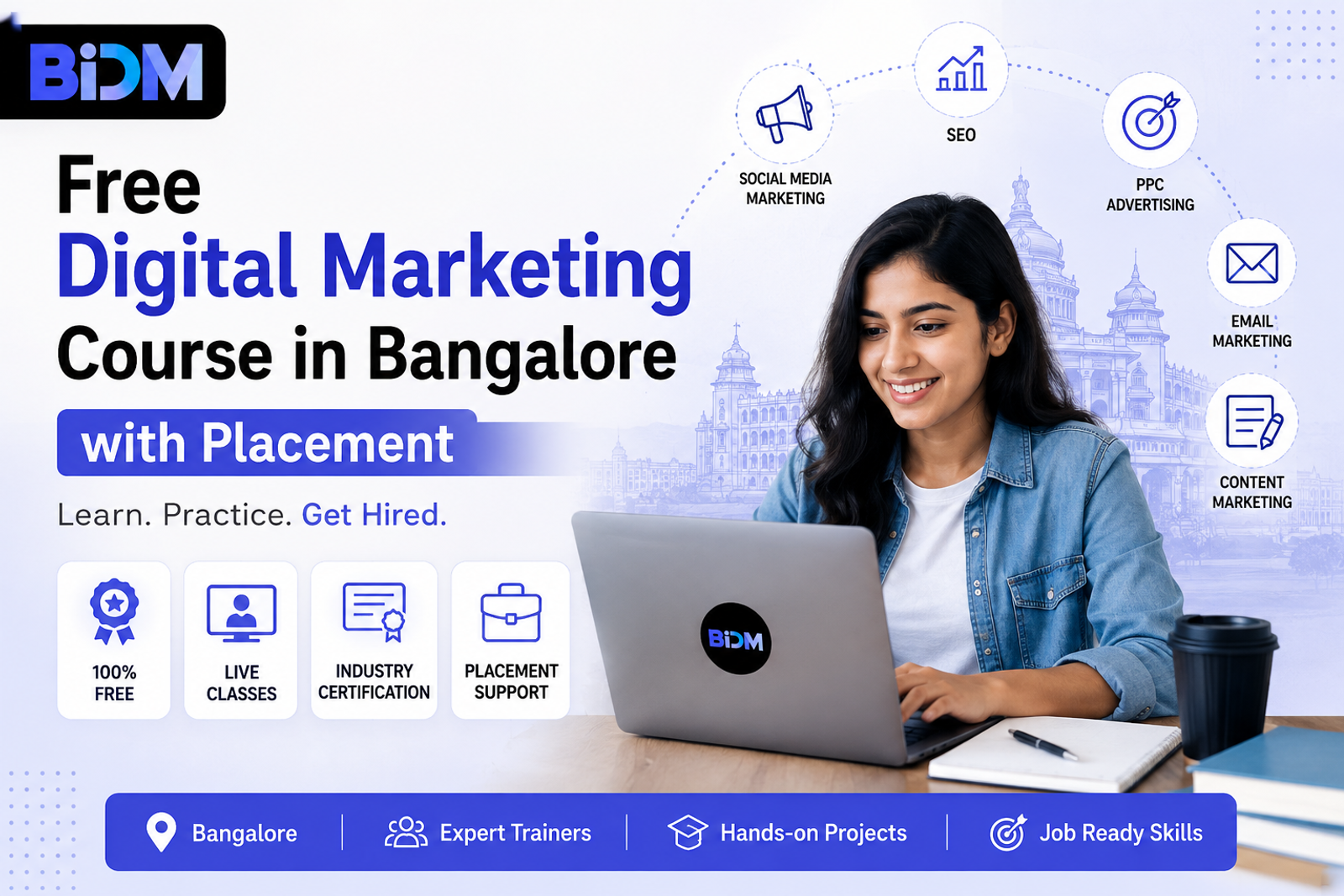
guide · Quick Answer (TL;DR)
Free digital marketing courses in Bangalore with placement are available through government-subsidized programs and private Pay After Placement (PAP) models. These programs can cover SEO, paid advertising, social media marketing, analytics, AI tools, practical projects, and industry certifications, with placement assistance available through some private institutes.
Key Takeaways & Data Points
- Digital marketing courses in Bangalore can follow two main models: government-subsidized programs and private Pay After Placement (PAP) programs.
- PAP programs may require ₹0 upfront tuition, with repayment beginning after securing a qualifying job above the agreed salary threshold.
- The blog reports 2026 fresher salary expectations of ₹2.5–₹4.5 LPA, depending on skills and specialization.
- Up-skilled graduates with AI skills and Google/Meta certifications are presented with an expected salary range of ₹3.5–₹4.5 LPA.
- The article highlights 50+ generative AI and automation tools as part of modern digital marketing training.
- Students can build portfolios through live websites, campaign case studies, technical SEO audits, AI prompt libraries, and verified industry certifications.
- The featured training pathway is described as approximately 2.5 months, including core training, practical assignments, AI tools, live projects, and career preparation.
Top 10 Free Digital Marketing Courses in Bangalore with Placement – 2026 Career Guide
Bangalore, often hailed as the Silicon Valley of India, continues to be the epicenter of tech innovation, startup growth, and corporate expansion. As thousands of brands migrate their operations online, the demand for qualified, performance-driven digital marketers has reached an all-time high. However, for fresh graduates, career switchers, and job seekers, upfront tuition fees can often present a significant barrier to entry.
Fortunately, you can launch a lucrative digital marketing career in Bangalore without paying steep advance fees. Through Pay After Placement (PAP) models and government-subsidized schemes, top training institutes like BIDM are democratizing education. These programs offer great placement assistance, cutting-edge AI-driven curriculum, and flexible payment terms designed to protect the student's financial stability. Graduates entering the market in 2026 can realistically expect starting salaries ranging from ₹4.5 to ₹6.5 LPA, with fast-track growth opportunities as they build hands-on expertise.
Understanding Free Digital Marketing Training with Job Placement
The phrase "free digital marketing course" can refer to a few distinct educational and financial structures. Understanding how these pathways work allows you to pick the model that aligns best with your financial situation and career goals. Broadly, free and zero-upfront training in Bangalore falls into two primary categories:
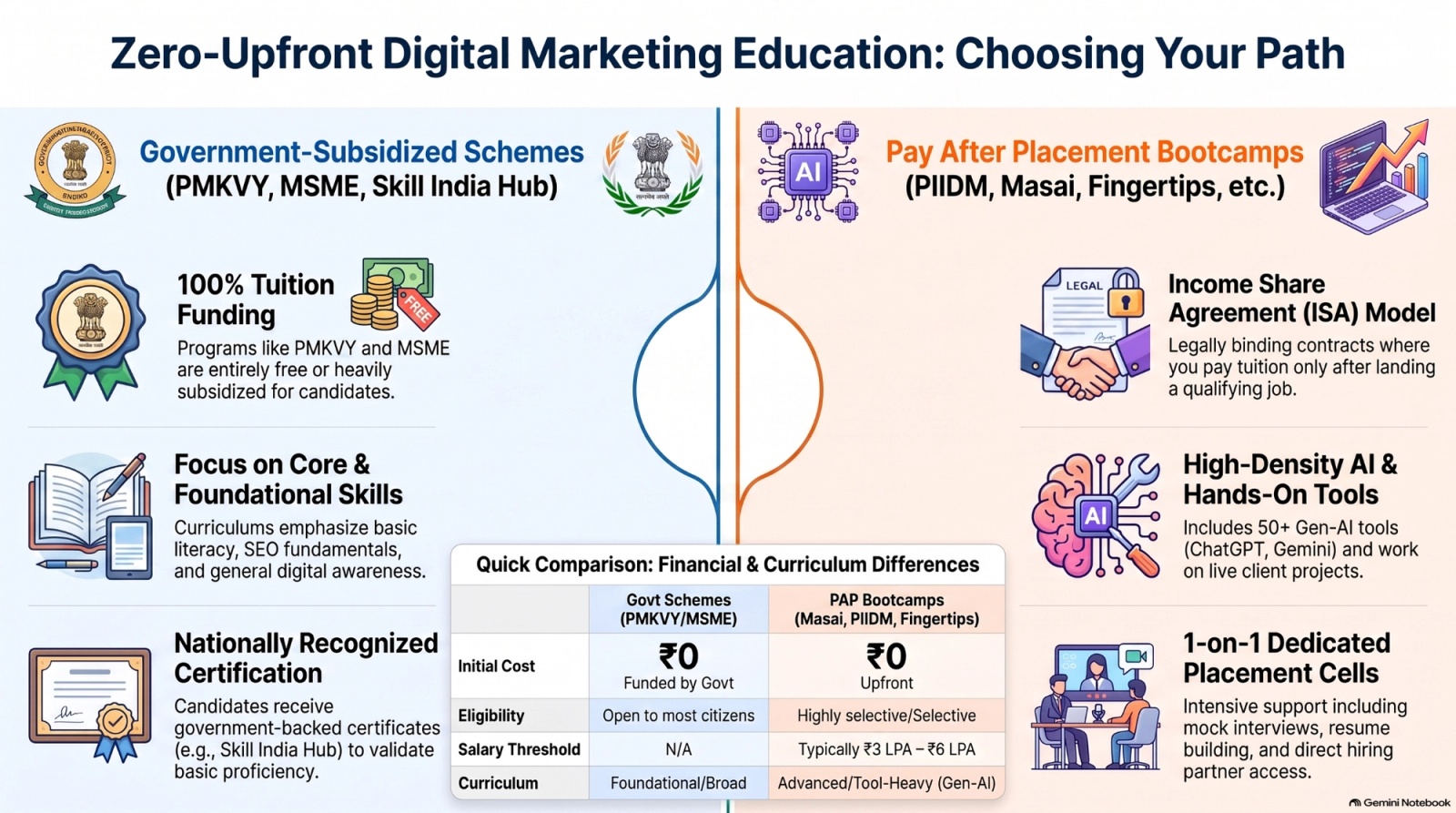
1. Government-Subsidized Schemes
Supported by central and state initiatives—such as the Pradhan Mantri Kaushal Vikas Yojana (PMKVY), Skill India, and various MSME (Micro, Small, and Medium Enterprises) programs—these courses are designed to boost employability among youth and job seekers.
- Cost Structure: Fully funded by government allocation; zero cost to eligible students.
- Target Audience: Fresh school graduates, unemployed youth, and individuals seeking entry-level skill development.
- Strengths: Excellent for grasping core marketing principles, terminology, and foundational digital strategies at zero risk.
2. Private Bootcamps with Pay After Placement (PAP)
Private institutes cater directly to corporate demand by producing job-ready candidates quickly. To make their programs accessible, institutes use the Pay After Placement framework:
- Cost Structure: You pay ₹0 upfront tuition. The institute absorbs the cost of training, infrastructure, mentorship, and software access.
- The Condition: You only reimburse the tuition fee once you successfully secure a job that pays above a pre-determined minimum salary (e.g., ₹3.0 LPA or ₹3.5 LPA).
- Shared Risk: Because the institute doesn't get paid unless you get hired, the risk shifts entirely from the student to the educational provider. This creates a strong incentive for the institute to maintain a modern, effective curriculum and active hiring partnerships.
At BIDM, students receive training across classroom and online delivery channels. The learning methodology relies heavily on live client projects, practical budgeting scenarios, and agency-level workflows rather than passive theoretical lectures.
How Does the Pay After Placement (PAP) Model Work?
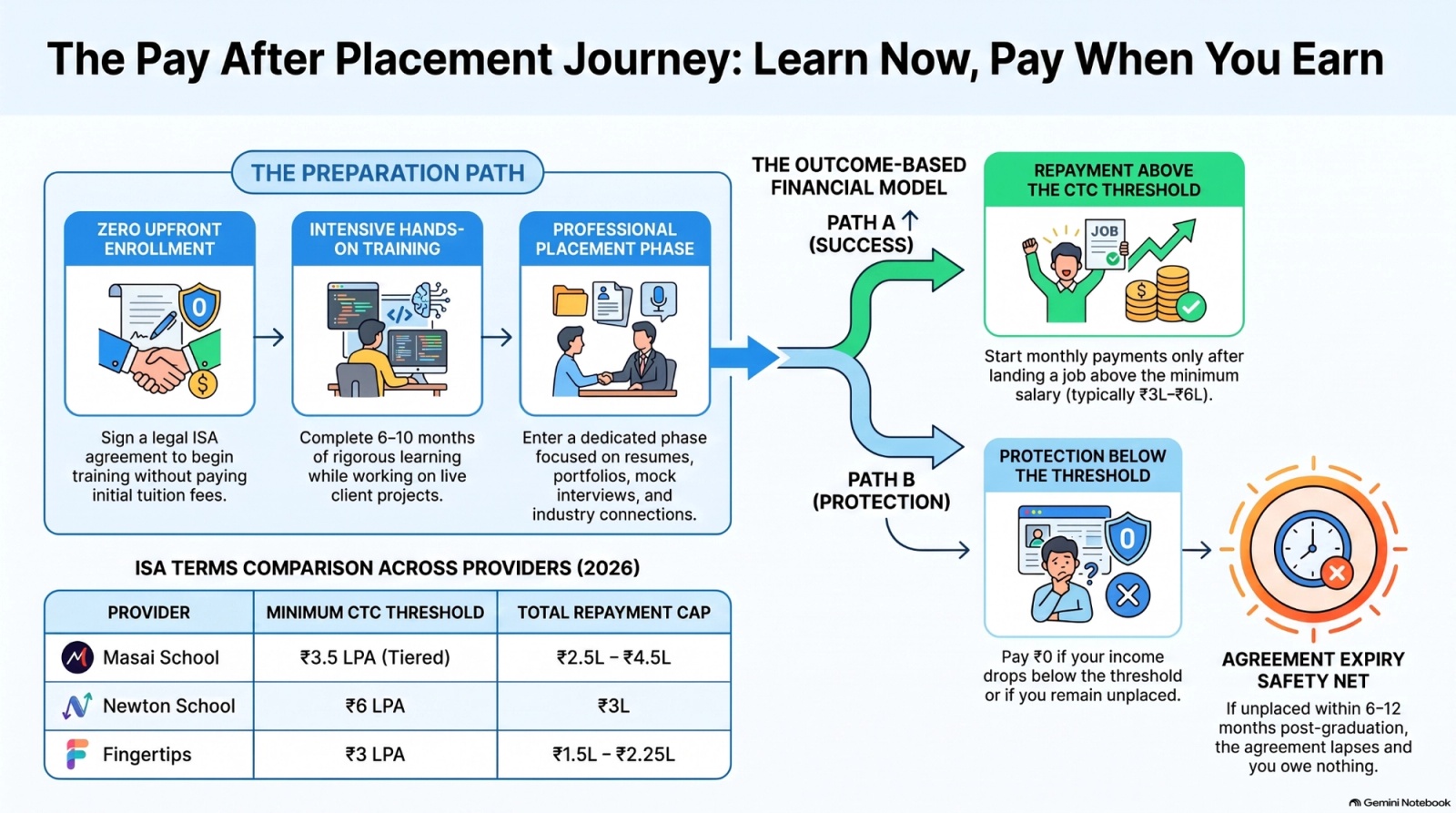
At the core of every authentic Pay After Placement framework lies an Income Share Agreement (ISA). An ISA is a legally binding financial contract signed between the student, the educational institution, and an official financial partner (an RBI-registered NBFC).
Instead of taking out a high-interest traditional student loan or paying flat upfront fees, the ISA links your education costs directly to your future earning potential.
Key Term: Cost to Company (CTC)
CTC represents the total annual expenditure an employer incurs on an employee. It includes base salary, allowances, performance bonuses, health insurance, provident fund (PF) contributions, and other benefits.
Core Mechanics of an Income Share Agreement
- The CTC Threshold: The agreement specifies a minimum salary level. For instance, if your ISA threshold is ₹3.5 LPA, you are not required to make any monthly payments if your starting salary is ₹3.2 LPA. Repayment begins only when your package meets or exceeds the threshold.
- Repayment Percentage & Duration: Once employed above the threshold, you pay a fixed percentage of your monthly gross income (typically 10% to 15%) for a set timeframe (usually 12 to 36 months).
- The Repayment Cap: To protect students who achieve high earnings shortly after graduating, every fair ISA includes a total cap. This is the absolute maximum amount you will ever pay, regardless of how quickly your salary escalates.
- The Placement Expiry Window: If you actively participate in interviews but do not land a qualifying offer within a specified period post-graduation (typically 6 to 12 months), the ISA expires. At that point, your financial obligation drops to zero.
Comparison of Popular PAP and Placement-Assisted Programs in Bangalore
Comparison of Popular PAP and Placement-Assisted Programs in Bangalore
| Institute / Provider | CTC Threshold | ISA Repayment Cap | Program Duration | Key Features |
|---|---|---|---|---|
| BIDM / PIIDM | Flexible Options | Affordable Capped Fee | 2.5 Months | Rapid hybrid learning, 50+ AI tools, live clients |
| Masai School | ₹3.5 LPA | ₹2.5 – ₹4.5 Lakh | 6–9 Months | Coding & Marketing tracks, strict attendance rules |
| The Skillians | Guaranteed CTC | Undisclosed | 8–10 Months | Full-stack agency immersion, portfolio focus |
| Fingertips | ₹3.0 LPA | ₹1.5 – ₹2.25 Lakh | 6 Months | Data-driven performance marketing focus |
Salary Expectations and Career Paths for Freshers in Bangalore
Bangalore hosts a dense concentration of multinational IT corporations, global capability centers (GCCs), hyper-growth startups, and specialized digital marketing agencies. This continuous corporate demand creates a reliable hiring pipeline for entry-level digital marketing professionals.
Expected Salary Brackets (2026 Data)
- Standard Freshers (Graduates with Basic Skills): ₹2.5 LPA to ₹3.2 LPA
- Up-Skilled Graduates (AI-fluent, Google/Meta Certified): ₹3.5 LPA to ₹4.5 LPA
- Specialized Roles (Data Analysts, Performance Marketers): ₹4.5 LPA to ₹6.0 LPA
Vijay Gehlot, founder of PIIDM, notes that the industry's baseline expectations have shifted: "Employers are no longer looking for candidates who simply understand theoretical definitions of SEO or social media. They want freshers who can navigate ad managers, interpret analytics dashboards, and leverage AI tools on day one to reduce operational costs."
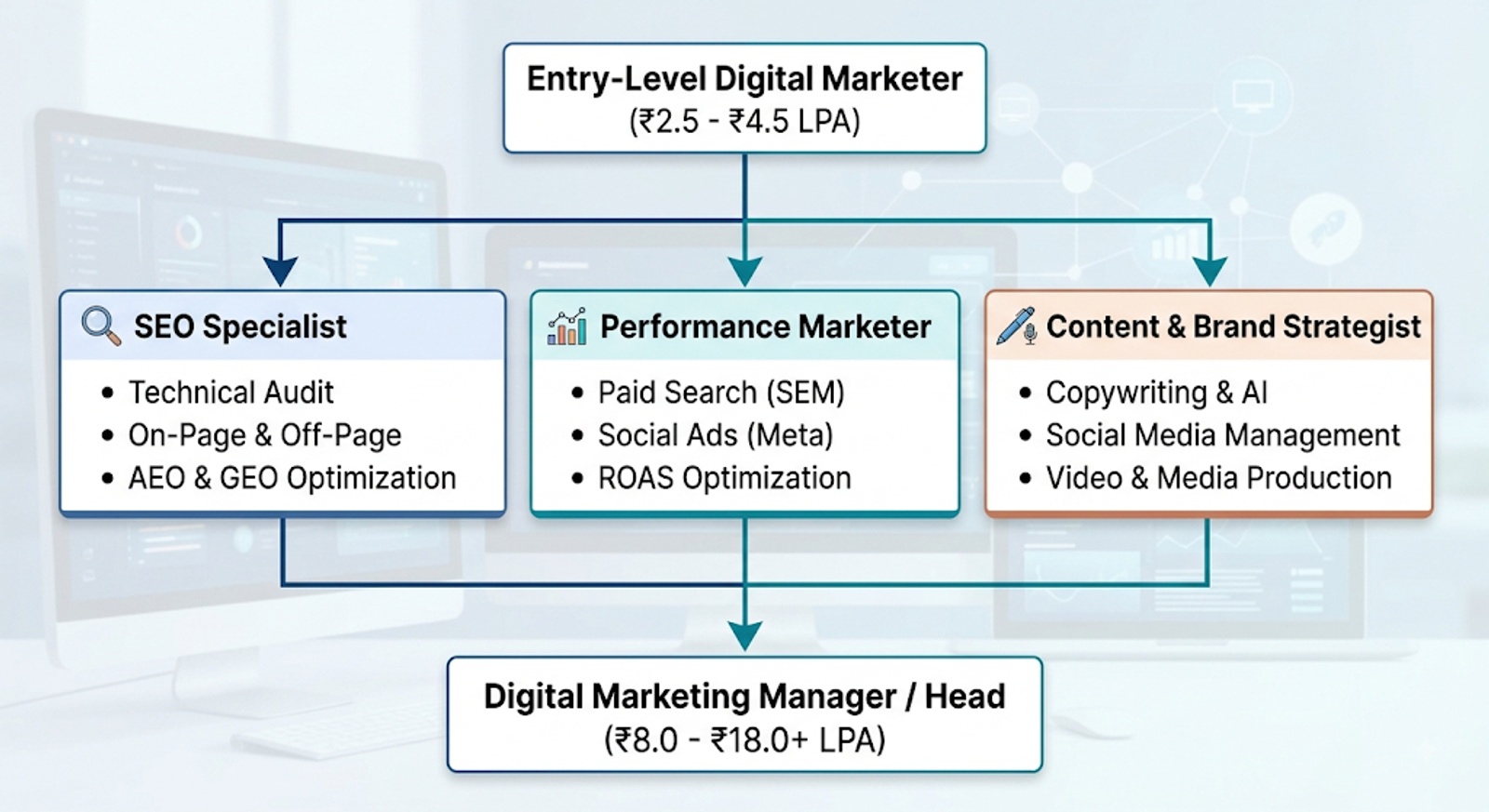
Top In-Demand Roles and Core Responsibilities
1. Search Engine Optimization (SEO) Specialist
- Focus: Improving organic search rankings, driving high-intent web traffic, and fixing site architecture.
- Key Tasks: Keyword research, backlink acquisition, technical site audits, mobile speed optimization, and structured data implementation.
2. Performance Marketer / Paid Media Executive
- Focus: Managing paid advertising budgets on search engines and social platforms to deliver direct ROI.
- Key Tasks: Setting up Meta Ad Manager and Google Ads campaigns, A/B testing ad creatives, tracking conversion pixels, and optimizing Return on Ad Spend (ROAS).
3. Content Strategist & Social Media Executive
- Focus: Building brand affinity, creating multimedia collateral, and maintaining active social channels.
- Key Tasks: Writing promotional copy, managing content calendars, crafting short-form video scripts (Reels/Shorts), and tracking engagement analytics.
4. Marketing Automation & CRM Specialist
- Focus: Nurturing leads through automated email workflows, customer segmentation, and lifecycle triggers.
- Key Tasks: Building drip sequences in tools like HubSpot or Mailchimp, maintaining database hygiene, and personalizing user journeys.
Deep-Dive: AI Tools Covered in a 2026 Digital Marketing Curriculum
The integration of artificial intelligence into daily workflows is the biggest change in modern digital marketing. A course that relies exclusively on traditional 2020-era practices leaves students unprepared for the market. Leading institutes like BIDM incorporate over 10 generative AI and automation platforms into their standard modules.
Core Generative AI Platforms
- Text & Copy Generation: Master ChatGPT (GPT-4o), Google Gemini, and Claude to generate landing page copy, ad hooks, email nurture sequences, and long-form blog outlines in minutes.
- Visual Asset Creation: Use tools like Leonardo AI, Midjourney, and Canva Magic Studio to create custom promotional graphics, royalty-free background assets, and ad variations without needing a dedicated graphic design team.
Prompt Engineering: The RTCCO Framework
To get usable, high-converting marketing materials from AI models, students learn structured prompt engineering techniques. BIDM teaches this using the RTCCO Framework:
- Role: Assign the AI a clear persona (e.g., "Act as a senior B2B SaaS copywriter with 10 years of experience").
- Task: Explicitly state the objective (e.g., "Write three high-converting Facebook ad copy variations for a local gym").
- Context: Supply necessary background details, audience demographics, and core pain points.
- Constraints: Define strict guardrails (e.g., "Keep copy under 150 words, do not use emojis, avoid hype-heavy language").
- Output Format: Detail how the final response should be structured (e.g., "Provide results in a 3-column table showing Headline, Primary Text, and Call to Action").
AEO and GEO: The Next Evolution of SEO
As search habits shift toward generative assistants like ChatGPT, Perplexity, and Google Search Generative Experience (SGE), traditional keyword placement alone is no longer enough. Modern courses prepare students for:
- Answer Engine Optimization (AEO): Structuring web content so conversational AI engines can easily extract direct, authoritative answers to user queries.
- Generative Engine Optimization (GEO): Optimizing brand citations, entity authority, and technical schemas so your business is featured in AI-generated summaries and recommendations.
Government-Sponsored Digital Marketing Programs
For individuals who want to build foundational skills without enrolling in private ISA bootcamps, government-backed programs offer valuable alternative pathways.
Key Government Programs
- Ministry of MSME Training Schemes: Designed to help small business owners and job seekers adopt digital tools, these short-term programs cover social media marketing, basic website creation, and local business listing setup. M.S. Kumar, founder of NIDM Bangalore and an industry veteran with 13+ years of experience, frequently highlights these initiatives as essential for providing equitable digital access to underrepresented communities.
- Skill India Digital Hub: A free platform offering self-paced online courses covering digital marketing basics, e-commerce management, and basic analytics. Completing these courses earns you a recognized certification issued by national skill councils.
Government Courses vs. Private PAP Bootcamps
Feature Government Initiatives (PMKVY / MSME) Private Bootcamps (BIDM / PAP) Cost100% Free / Subsidized Zero Upfront (Pay after getting hired) Curriculum Focus Foundational concepts & basic tools Advanced 2026 AI tools, live ad budgets Practical Exposure Simulated exercises Live client accounts & real spend Placement Mechanism Job fairs & portal access Dedicated placement manager & mock interviews Pace Fixed, standardized Intensive, fast-track bootcamps
Practical Portfolio Checklist: How to Land Your First Role
Completing a course is only half the battle. To stand out to hiring managers in Bangalore's competitive market, freshers need a concrete portfolio that demonstrates practical execution. Here is what your portfolio should include upon graduation:
- A Live WordPress Website: Build and host a simple niche blog or local service website to demonstrate site creation, basic DNS management, and on-page formatting skills.
- Real Campaign Case Studies: Document a simulated or live paid campaign budget, highlighting your key metrics: Impressions, Click-Through Rate (CTR), Cost Per Click (CPC), and Return on Ad Spend (ROAS).
- A Technical SEO Audit: Perform a full audit on an existing website using free tiers of tools like Screaming Frog, Ahrefs, or Google Search Console, detailing clear technical fixes.
- An AI Prompt Library: Share examples of your customized prompt frameworks and the corresponding marketing outputs (blog posts, ad copy, image assets) created using tools like ChatGPT and Leonardo AI.
- Verified Industry Certificates: Show verified credentials earned through Google Skillshop, Meta Blueprint, and HubSpot Academy.
Frequently Asked Questions
Written by
Aameena AhmediDigital marketing professional specializing in SEO, content strategy, and brand growth.