Digital Marketing Course in Bangalore: Is It Worth Doing? (Value & ROI)

guide · Quick Answer (TL;DR)
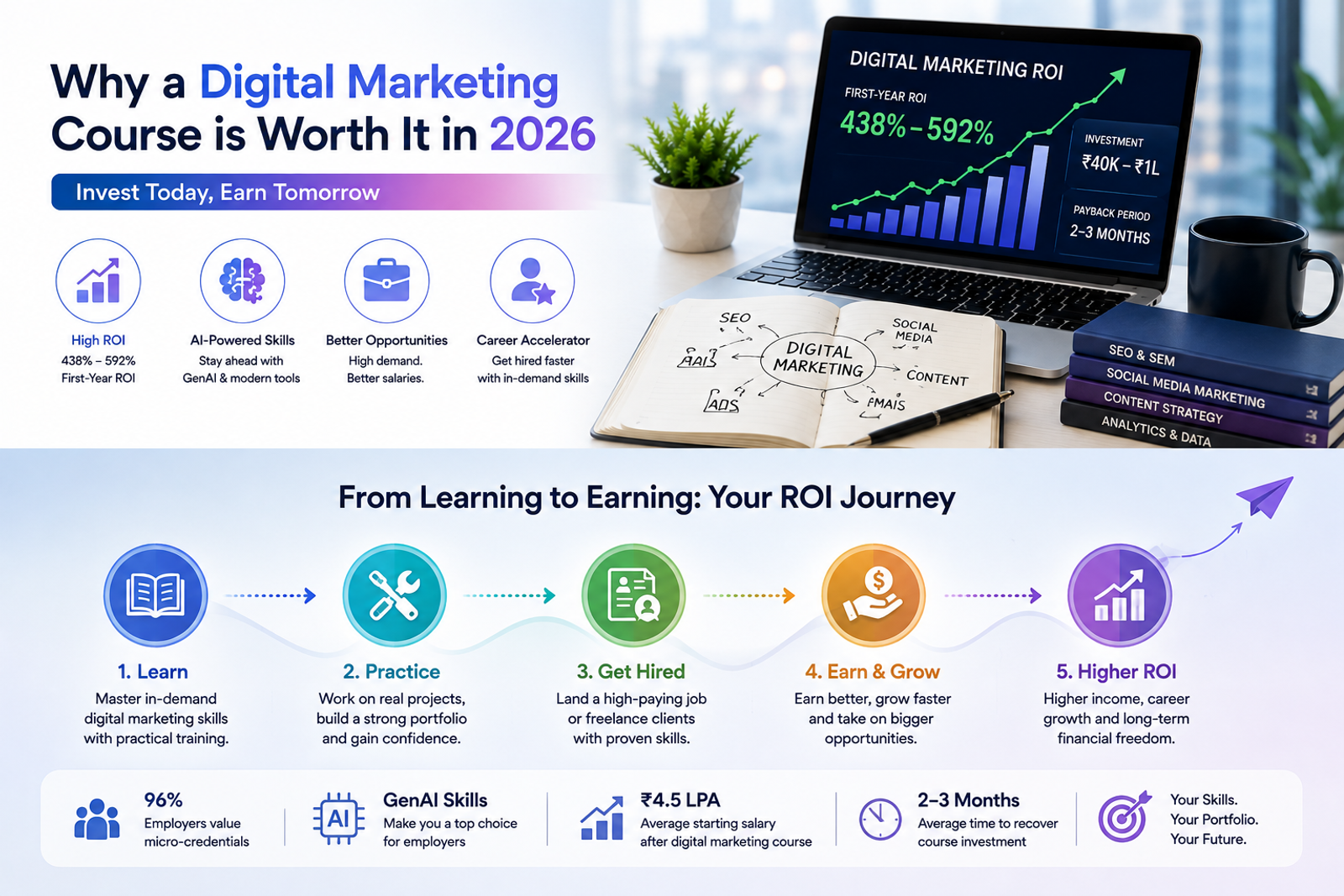
- •A digital marketing course is highly worth the investment in 2026, delivering a substantial 438% to 592% first-year ROI as freshers can recover typical course fees (₹40,000–₹1,00,000) within two to three months of employment.
- •Modern certificates act as cost-effective credibility accelerators that bypass traditional four-year degrees, provided the curriculum integrates Generative AI and platform tool fluency.
- •However, to secure top roles, candidates must pair their credentials with a documented portfolio of real projects to prove practical execution capability and budget management.
Key Takeaways & Data Points
- Indian Training Cost Sweet Spot: For a professional, job-ready digital marketing course in India in 2026, the optimal sweet spot is between ₹35,000 and ₹1,00,000
- According to a 2024 DMI Graduate Survey, 93% of alumni report that earning a Digital Marketing Institute (DMI) certification had a positive impact on their career, and 74% received a salary increase
- Globally, 86% of employers state they are more likely to hire candidates who hold a DMI Skills Certification on their CV
- Content marketing generates 3 times more leads than traditional outbound marketing while costing 62% less per lead
- The median Return on Investment for Search Engine Optimization (SEO) campaigns is 748% over a three-year period
- Entry-level employees who hold a GenAI micro-credential report a 70% increase in productivity and 63% better problem-solving capabilities
Are you someone who is wondering if doing a digital marketing course is worth it or not?
Yes, a digital marketing course is definitely worth it from 2026 onwards if the digital marketing course has Generative AI integrated and portfolio building in real life.
A certified diploma program would fall under the ₹25000 to ₹65,000 band in Bangalore and can reap 400% to 500% first-year ROI. Those graduate jobs which commence from ₹3.5 to ₹6 LPA also allow for a two or three-month repayment of initial tuition costs through a full-time role.
Understanding Digital Marketing Course ROI in Bangalore
Digital marketing courses have proven to offer a great ROI.
We calculate ROI with the formula (1st year salary - course cost) / course cost. This means as a fresher, if you earn ₹4.5 LPA directly after taking this course which costs ₹65,000 to complete, that would take us to an ROI of 592% in the very first year!
Return on Investment: (Benefit of investment – Cost of investment) / Cost of investment.
When you invest in your education, it's never a waste, you get speed, you get a system of accountability, and you get direct access to career placement services. In maths, 74% is a strong preference for entry-level digital marketers.
The Indian digital marketing market is expected to cross around $24 billion by the end of 2026. That fast growth in the market has created a real talent shortage which means employers are willing to pay top dollar for proven skills.
A 2025 Lumina Foundation report showed that candidates with recognized micro-credentials land starting salaries 10% to 15% higher, with nine out of ten surveyed employers offering them. Micro-credentials are simply evidence that you have skills and knowledge that are validated in the real world. It’s not just about looking at your pay cheque, it’s what ROI you are bringing to your employer.
SQ Magazine’s analysis showed a strong positive average customer acquisition cost (CAC) return of $7.65 for every $1 spent over three years. And First Page Sage data from 2026 shows that SEO (the practice of ranking content organically on search engines) delivered a median ROI of 748% over three years. With these compounding returns passing through a tech agency in Bangalore, it’s easy to see how quickly upfront tuition pays for itself with your own ROI calculator.
You have to factor in the intangible value, too. Time spent on your education will increase your confidence, your credibility and your network. Just by being part of a peer group and getting live mentorship from industry experts, you instantly raise your personal value by 5% to 10% before you even finish your first lesson.
Budgeting for Hidden Costs
Never decide a course by looking at its sticker price only. Digital marketing requires professional software. You'll run out of money halfway through the course if your institute doesn't provide open access to these tools. Annual subscriptions to industry-standard tools will further cost you ₹5,000 - ₹15,000.
True Cost Checklist:
- Tuition for Course: The initial amount that students will pay to the institute.
- SEO Software (like Ahrefs or SEMrush): ₹5,000 - ₹20,000/year — Tools used for keyword research and competitor analysis.
- Design Tool: Canva Pro (₹3,000 – ₹5,000 per year [Varies from tool to tool]) — Tool for creatives on social media.
- Domain and Hosting: The infrastructure for an independent portfolio of your own (₹2,000 - ₹5,000/yearly).
- Ad Practice Budgets: (Live capital ₹2,000 - ₹5,000) for running experimental campaigns on Meta or Google.
Digital Marketing Certificate vs. University Degree: Which Is Better?
University degrees take 3 to 4 years building long-term theory, often falling behind fast-moving technology. In contrast, a digital marketing certificate takes just 2 to 6 months of hands-on practice, focusing entirely on execution and getting you ready for a job right away.
We are right in the middle of a major shift toward skills-based hiring, where companies hire based on proven abilities rather than a traditional 4-year degree that lacks real-world value. Between 2024 and 2026, the share of employers using or testing skills-based hiring jumped from about 77% to 97%.
As Francesca Lockhart, Professor and Cybersecurity Clinic Program Lead at the University of Texas at Austin, puts it: "Employer demand for skills-based hiring necessarily needs that educators prioritize skills-based learning; our curricula must adapt to prepare students for a job market where sought-after qualifications are changing too rapidly for traditional education models to keep up."
Curriculum and ROI Comparison Matrix
Feature
| Feature | University Degree | Digital Marketing Certification |
|---|---|---|
| Completion Time | 3 to 4 Years | 2 to 6 Months |
| Financial Investment | High (₹5,00,000+) | Low/Medium (₹40,000 - ₹1,00,000) |
| Curriculum Focus | Extensive theory, consumer behavior, and management. | Practical execution, fluency in relevant platforms, and skill in data analysis. |
| Agility & Currency | Often out of date; relies on static textbooks. | Super up-to-date; trends with platform algorithms and AI. |
| Primary Outcome | Formal degree and durable academic power. | Portfolio, micro-credentials, and speed to market. |
If you are only looking to hire immediately in the busy tech and startup ecosystem of Bangalore, then the certificate route has a far better timeline and break-even point.
Real-World Work vs. Certifications: What Is More Important?
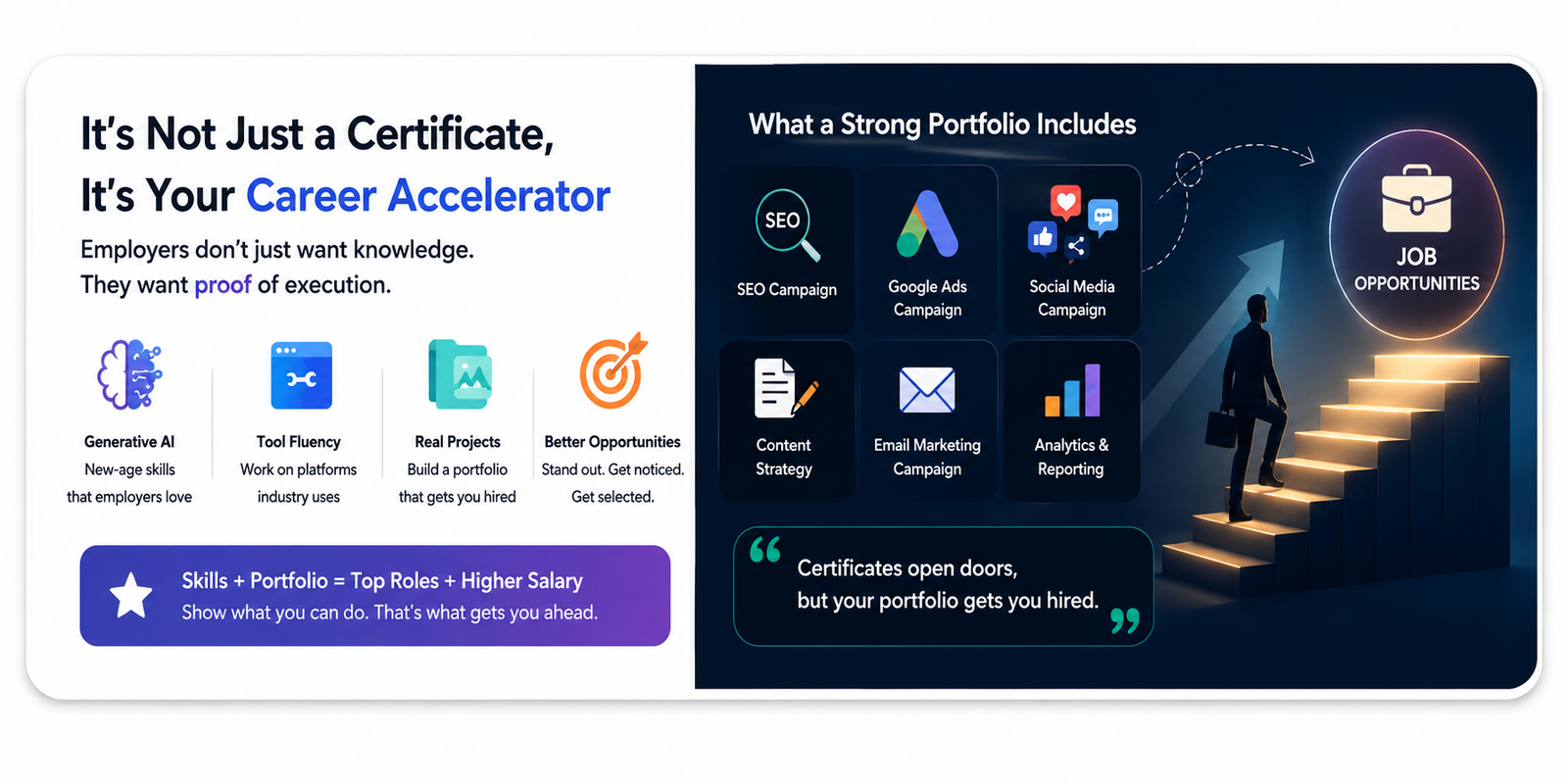
Certifications only give you the basic vocabulary in a safe, controlled setting, whereas real-world projects come with actual financial risk and responsibility. At the end of the day, hiring managers care much more about real campaign metrics in an independent portfolio than a theoretical badge.
Passing a multiple-choice test to get a digital badge doesn't prove you know how to handle a crisis when a live campaign stops converting. Riten Debnath, founder of Fueler, hits on this exact problem in his book Scorecard to Insight: "Course completion badges look good on paper, but mostly don't indicate whether a candidate would be able to manage ad budgets, fix conversion rates going down, or achieve revenue growth in actual terms."
Live campaigns force you to step up and take operational accountability. If your audience targeting is off, you waste real money right away. You have to deal with broken tracking tags, tweak ad copy based on real feedback, and work across teams. Certifications give you a risk-free space where mistakes cost nothing, but the real world doesn't work that way.
That said, getting certified is still useful for passing automated resume filters and proving you know the basics. The real winning move is combining a formal certificate with hard proof of your work. That's why students at BIDM work with live ad budgets to build verified, stand-alone portfolios that go far beyond what traditional education offers.
Building a No-Funds Portfolio Without Employment
You do not need a company that will take you up on your work before showing that you're worth the salary. Stack a well-rounded portfolio of your Pay-Per-Click (PPC) just from the comfort of your own living room!
- Start a Digital Asset: Buy inexpensive hosting and start a WordPress blog, or create a super-niche social media channel (e.g., "Marketing in Bangalore SaaS").
- Integrate Analytics: Integrate Google Analytics 4 (GA4), install Google Search Console, and track every visitor, click, and user path of your asset.
- Run an Organic Strategy: Create 10 keyword-optimized posts. To get better at it, keep a record of your keyword research, on-page optimization, and distribution process.
- Run a Micro-Budget Campaign: Invest ₹1,000 on a Meta Ads campaign driving visitors to your best content. Log your ad copy A/B testing and compute your Return on Ad Spend (ROAS).
- Create the Case Study: Bundle this up as a PDF and include your screenshots, data dashboards, and failure analyses. Define the problem, strategy, execution, and some data-driven outcomes.
Why Are AI Modules Indispensable in 2026 Courses?
Generative AI is transforming digital marketing by automating manual tasks and heavily boosting productivity. With 92% of employers seeking candidates who have GenAI skills, any digital marketing course that leaves out AI training is essentially outdated.
At its core, Generative AI refers to systems that create text, images, code, and other media straight from prompts. In marketing, it has shifted from a cool new gadget to the main engine driving operations—used for writing quick ad copy, predicting data trends, and automating daily workflows. Skipping GenAI integration in a digital marketing curriculum today means falling completely behind what the job market demands.
As Marni Baker Stein, Chief Content Officer at Coursera, points out: "In a time when the labor market is changing so quickly, almost nine in 10 learners feel micro-credentials are essential to help them ultimately find work."
AI is also rewriting how people look for and consume information. Answer Engine Optimization (AEO) is quickly taking over traditional SEO, focusing on how webmasters structure content so it gets directly cited by AI chatbots like ChatGPT or Perplexity. Because this kind of AI traffic is nearly impossible to track using standard web analytics, marketers face a massive measurement gap. You have to learn how to write "citation-worthy" content that AI tools naturally pull and reference.
To keep students ahead of the curve, BIDM fully integrates Generative AI into its Bangalore curriculum, teaching prompt techniques, AEO mechanics, and predictive analytics right alongside classic digital marketing strategies.
Frequently Asked Questions
Written by
M. Taufiya TazeenResults-driven Digital Marketing Specialist and Content Expert with over 3 years of experience in SEO writing and optimization.